
Nov 16: New insights in diagnosis and treatment of immune deficiencies

In his PhD thesis, Bas Smits (UMC Utrecht) describes the discovery of two new genes that can cause primary antibody disorders. He also elucidated the role of T cells in intestinal inflammation and demonstrated how T cells can be inhibited in vitro. Furthermore, he discovered that antibiotics and antibodies work equally well in preventing infections in patients with mild PAD and described risk factors that can predict which patients develop lung damage. Finally, Bas Smits was the first to outline both first- and second-line therapies for lung autoimmunity.

The immune system is a complex network of specialized cells and proteins that protect humans against pathogens such as bacteria and viruses. It comprises various types of white blood cells, including B cells, T cells, and NK cells, each with specific functions in combating infections. B cells can produce antibodies to neutralize pathogens, T cells can kill infected cells and coordinate the immune response, and NK cells can detect and eliminate abnormal cells. Primary antibody disorders (PADs) are hereditary conditions in which B cells do not function properly, making it challenging for the immune system to produce antibodies. This dysfunction not only leads to recurrent infections but can also result in autoimmunity, which can cause lung damage. T cells play a significant role in this autoimmunity, and previous research has shown that these immune cells can trigger autoimmune reactions in the intestines and lungs of patients with PIDs. The aims of the PhD research of Bas Smits (Department of Paediatric Immunology and Rheumatology, UMC Utrecht) was to improve the understanding of the pathophysiology of (monogenetic) PAD and to identify new ways to improve management of infectious sequelae and noninfectious complications of PAD.
New genes
In his PhD thesis, Bas Smits (UMC Utrecht) describes the discovery of two new genes that can cause primary antibody disorders. He also elucidated the role of T cells in intestinal inflammation and demonstrated how T cells can be inhibited in vitro. Furthermore, he discovered that antibiotics and antibodies work equally well in preventing infections in patients with mild PAD and described risk factors that can predict which patients develop lung damage. Finally, Bas Smits was the first to outline both first- and second-line therapies for lung autoimmunity.
This thesis outlines some vital improvements in the care of patients with antibody disorders. However, future research into personalized care for these patients is essential. According to Smits, this research should be conducted in an international, multidisciplinary context to enhance the diagnosis, treatment, and monitoring of antibody disorders and provide patients with more effective treatment options.
Immune deficiency
Symptomatic PADs are the most common symptomatic form of primary immunodeficiency. They are estimated to occur in 1 in 2.000 – 1 in 10.000 people worldwide and usually present before the age of 30 years. PADs are a heterogenous group of diseases characterized by reduced immunoglobulin production, that can be further classified based on the types of immunoglobulins that are missing and the severity of the immunoglobulin deficiency. Recurrent infections (in particular of the respiratory and gastro-intestinal tract) are frequently the presenting symptom in patients with a PAD. Infection prevention measures like vaccination, prophylactic antibiotics and immunoglobulin replacement therapy have been implemented successfully to combat infections in PADs.
PhD defense
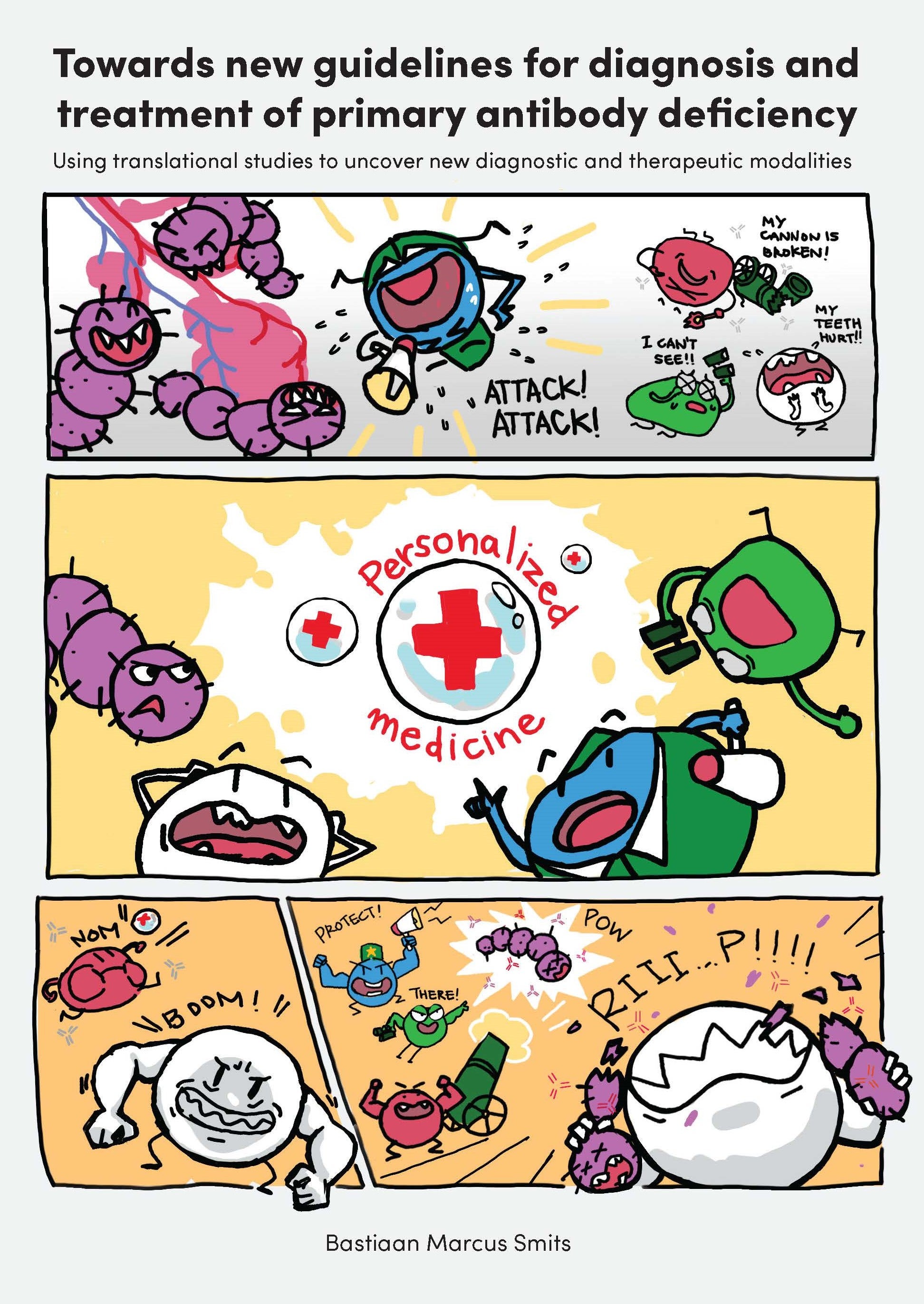
Bas Smits (1990, Utrecht) defended his PhD thesis on November 15, 2023 at Utrecht University. The title of his thesis was “Towards new guidelines for diagnosis and treatment of primary antibody deficiency – Using translational studies to uncover new diagnostic and therapeutic modalities.” Supervisors were em. prof. Nico Wulffraat MD PhD and Joris van Montfrans MD PhD (both Department of Paediatric Immunology and Rheumatology, UMC Utrecht) Co-supervisors were Stefan Nierkens PhD and Marianne Boes PhD (both Center for Translational Immunology, UMC Utrecht). Bas Smits currently works as a resident not-in-training at the Department of Internal Medicine at the St. Antonius Hospital in Nieuwegein.