
Amanda on the rare condition oligodontia
"Now I am myself!"
Amanda Vos is very satisfied with her dentures, made at the UMC Utrecht. As a child, she was missing a number of teeth. Others erupted in unusual places during the tooth eruption process, for example in the palate. This rare condition is called oligodontia.
In her parents' house, Amanda Vos (20 years old) runs her own childcare business, Het Vossenhol. And it is running smoothly. Five days a week, she cares for children from infancy up to about eight years old. Soft sofas, a cheerful changing table, a doll corner: the house is furnished for it. “I love children. And it is fun to teach them all sorts of things through play,” says Amanda. She completed the Care & Welfare Assistant training in her hometown of Tiel and supplemented it with courses for pedagogical childminder, First Aid, and CPR for children. Her mother immediately thought it was a good idea when Amanda wanted to start Het Vossenhol. The two do a lot together, including the administration. “We are real family people. A cozy atmosphere is very important.”
First teeth
Seven years after her brother Wesley, Amanda was born in 1996 as the second child of the family. The new girl's fingers and toes were very short, present only up to the first joint at most. Amanda's upper lip also turned inward slightly. When her first teeth started to come through, her mother noticed that the process was different from usual. The baby teeth were smaller, and some were missing. Later, during the transition to permanent teeth, her adult dentition also failed to develop properly. Some teeth were missing, canines erupted in the place of normal teeth, and others in the palate. New front teeth were missing from the upper jaw. “As a child, I was ashamed,” Amanda says. “My hands already made me different, but that bothered me much less than my teeth. I didn't dare look other people in the eye, I spoke differently, and I lisped a lot. And because of the missing front teeth, my mouth looked like a dark hole.”
buy Barbie
A long series of visits to the dentist followed. “That was really traumatic,” Amanda says. “The dentist didn’t know what was wrong. He thought he could solve the problem with braces. He attached a piece of my upper lip to the braces. That hurt terribly for weeks. Absolutely awful. I couldn’t eat anything, at most a little applesauce.”
Her mother is at her wit's end. She dreads going to the dentist with Amanda. “I was so scared. At one point, my mother just stopped mentioning it when we had an appointment,” Amanda says. “Then she would pick me up from school and we would go buy a new Barbie first.”
To trust
At the age of eleven, Amanda ended up with Dr. Créton, a dentist at the UMC Utrecht, through another dentist who quickly referred her. “At first, I didn’t want to. My mother insisted; she said: ‘Amanda, we are going to do this. You will be a beautiful girl.’ I didn’t like the idea: so young, and then a prosthesis,” Amanda recalls. “I always went to the dentist with fear, but when I lay down in Dr. Créton’s chair, she first reassured me. She said that everything would be fine. She rebuilt my confidence. That was nice, because at that time I felt very insecure and withdrew easily. Fortunately, I went to a nice primary school and was never bullied.”
Healthy baguette
In 2007 and 2008, Amanda frequently visited the UMC Utrecht to have new dentures fitted. “It was quite a process, but very pleasant. Doctor Créton is a sweetheart. She takes all the time for you and asks what you like. I was allowed to choose the shape and color of the new teeth myself. Based on her experience, she gave honest and sincere advice. She works with you to find the solution that suits you.” The new dentures came with a veneer covering the teeth Amanda had developed. Just before the summer holidays, right before she started secondary school, the dentures were ready. “When I looked in the mirror in the treatment room and saw how beautiful it was, I immediately thought: now I am myself! My mother and I cried a lot. We were so happy. I will never forget that moment,” says Amanda. The first thing she did after that was eat a healthy baguette at the UMC Utrecht. “Delicious! That wasn't possible at first, because hard rolls always hurt.”
New start
“Of course, the new dentures took some getting used to: you feel that there is something extra in your mouth. And sometimes I accidentally bumped my teeth with a glass. That’s okay. Because they fit so nicely, my mouth looks neat and well-groomed again. Now I am just like everyone else.”
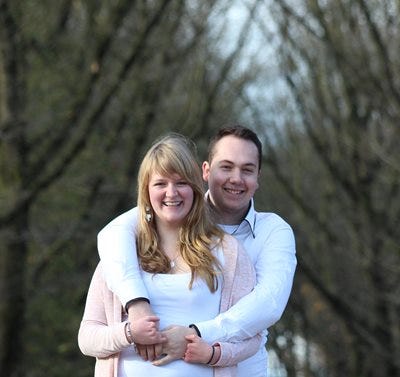
Amanda looks forward to the future with optimism. “I’ve had a boyfriend, Kevin, since I was fourteen. I did put off telling him for quite a while that I have dentures. Doctor Créton said: ‘You really have to do it, because if he leaves you because of that, he’s not the one.’ Fortunately, Kevin reacted very well. Our relationship is fine; everything is open for discussion.”
Amanda wants to move in with her partner at some point. Eventually, she also wants children. “But I do want to know first whether they could also become disabled,” she says. Genetic research was conducted at the UMC Utrecht in 2010, but it did not yield a clear picture at the time. The techniques that have become available since then might yield better results. Amanda is considering having her DNA re-tested. “The most important thing is that a child can play, that their freedom is not restricted,” says Amanda. “All children need that. And that is also what I love so much about my business: offering children a cheerful and pleasant place.”
I was ashamed and felt insecure. With the teeth I have now, I am myself.
Center for Congenital Facial and Dental Anomalies
Congenital abnormalities of the face and mouth are visible and require treatment by multiple specialists. In the center of expertise hypodontia (too few teeth) and cleft lip, jaw, and palate in combination with other facial abnormalities are treated.
Thank you for your response!